This week, we dive deep into Acts 10 to explore the paradigm-shifting story of Peter and Cornelius. Discover how the Holy Spirit smashes the cultural, racial, and spiritual barriers human beings spend centuries constructing, and learn why the biggest obstacle to God’s mission is often the assumptions hidden inside our own hearts. It’s time to stop building walls and start building bridges.


Follow along with the field guide
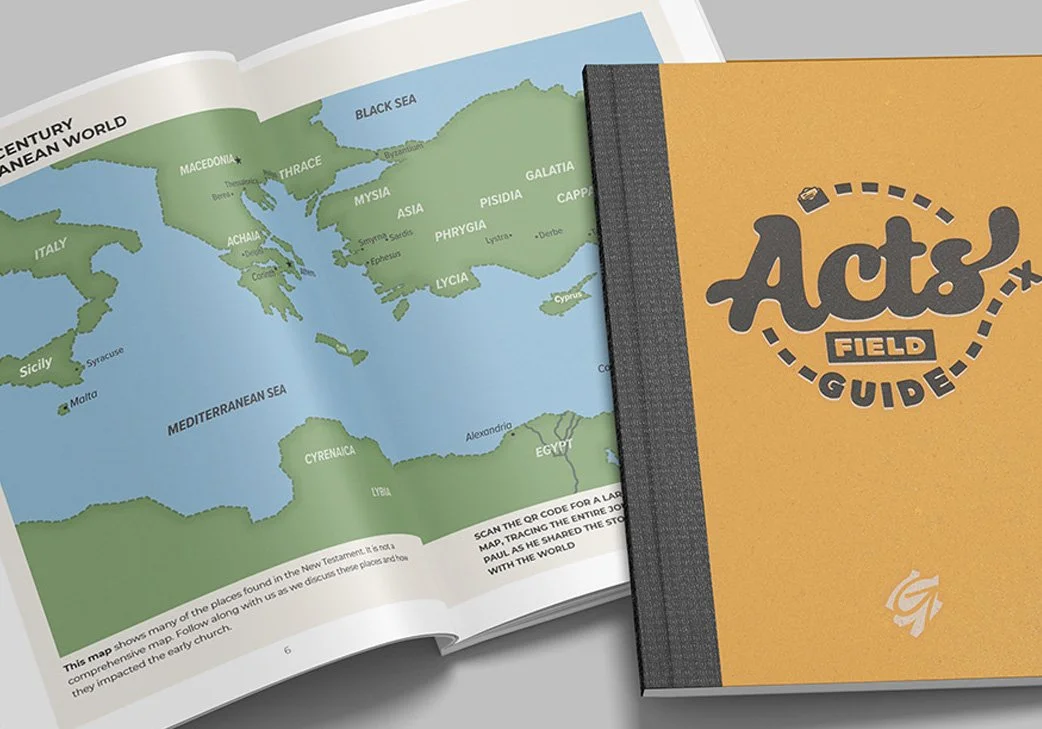
The Spirit is on the move. Download your Field Guide and bring it each week — there's space inside to write, reflect, and record what God is saying to you through Acts.
Digging Deeper
Digging Deeper: Break Down Barriers
LEAN IN
Think about a time when you felt like an outsider—maybe at school, on a team, in a social setting, or even at church.
- What made you feel excluded or welcomed?
- Who helped make you feel seen and accepted?
- Why do you think people naturally build walls between one another?
LOOK UP
Main Passage: Break up the passage and read aloud in your group- Acts 10
Make some observations (What does the text say?):
- What stands out to you in Peter’s vision?
- What repeated phrases or ideas do you notice?
- What do you notice about Cornelius?
- How does Peter initially respond to God’s command?
- What changes in Peter throughout the story?
- What barriers existed between Jews and Gentiles?
- What surprises you most about the way God works in this chapter?
- Where do you see the Holy Spirit leading people outside their comfort zones?
What are you curious about?
- Why do you think Peter resisted God at first?
- Why was eating together such a big deal in this culture?
- Why do you think God gave Peter a vision instead of simply telling him what to do?
Interpretation (What does the passage mean?)
What do you learn about God?
- God pursues people from every background.
- God is already working in places and people we may overlook.
- The Holy Spirit breaks down walls that divide people.
- God’s grace is bigger than human categories.
- What does this teach us about the heart of God?
- Why is this such a radical statement coming from Peter?
What do you learn about humanity?
- Humans naturally create categories and divisions.
- We often assume people who are different from us do not belong.
- Even sincere believers can carry prejudice, bias, or blind spots.
- We tend to gravitate toward comfort and familiarity instead of mission.
- How does Jesus bring people together?
- Why is unity in the church so important to the gospel?
Why do you think the gospel threatens division and superiority so deeply?
Application (What’s my response?)
How are you encouraged, challenged, or convicted by this passage?
- Are there people or groups you tend to avoid, judge, or misunderstand?
- Where might God be stretching your heart beyond your comfort zone?
- Have you ever limited who you thought God could reach?
- What assumptions or biases might the Holy Spirit want to confront in you?
- What would it look like to stop resisting the ways God wants to grow you?
- Is there a relationship where God may be asking you to build a bridge instead of a wall?
What should be our response to this passage?
- To repent of prejudice, pride, and exclusion.
- To welcome others the way Jesus welcomed us.
- To become people who build bridges instead of barriers.
- To join God in reaching people who are different from us.
Reflective Questions
- Who in your life may feel overlooked, excluded, or spiritually “far away”?
- How can our group become more welcoming and intentional toward others?
- What practical step can you take this week to reflect the inclusive love of Jesus?
- How does this picture of heaven challenge the way we live now?
- How should the future kingdom shape the culture of our church today?
Scripture
- Acts 10:9-35
- Acts 10:34-35
- Acts 11:17
- Ephesians 2:13-14
- Revelation 7:9
Prayer Guide
- Ask God to reveal any prejudice, pride, fear, or assumptions in your heart.
- Pray for humility and openness to the leading of the Holy Spirit.
- Pray that your group and church would reflect the welcoming heart of Jesus.
- Pray for people in your life who feel far from God or disconnected from church.
- Ask God to help you become a bridge-builder in your school, workplace, family, and community. Pray for unity in the church across cultures, generations, and backgrounds.
Practice (STEP OUT)
- Share a Meal With Someone Different From You
This week, intentionally spend time with someone outside your normal circle—someone from a different background, generation, culture, or life experience. Listen to their story and practice hospitality.
- Invite Someone Into Community
Invite someone to church, youth, small group, or an upcoming church event who may normally feel overlooked or hesitant to attend.
- Pray for Open Eyes
Each morning this week, pray: “Holy Spirit, help me notice the people you want me to love today.” Ask God to help you see people the way He sees them.
Message Transcript
Welcome to Gateway Church. My name is Carlos, our senior pastor. We have people watching from Buda, South, and online. So if you’re in the room here at North, let me welcome everybody who is watching along with us today. We are so glad that you are with us. I know many of you travel, you watch during the week, and it’s so good that you keep up. If as you walked in you had the ability, or if you brought it back, take out your little book—your field guide. Go ahead and take those out, if you will, if you’re taking notes. We’re making sure we are mindful of what God is doing, not just in Scripture, but what God is doing in us so we can go back after the series and read back on some things that we learned.
If you go right to the middle of the book, though, pages ten and 11, just open it up real quick. That’s where we ended last week with our ten-dollar challenge, where we asked every teenager, every kid, every young adult, and every adult to give $10 towards Bibles and backpacks. This is an effort to partner with two people who are part of our church, who are doing things in the community, who have said yes to what the Holy Spirit showed them to do, and they are feeding kids. They’re helping provide school supplies and a Bible for families through two different organizations. I had a goal of $10 per person, figuring that if we could raise $15,000, it would go a long way to pay for the Bibles and help pay for kids who are needing food, especially during this summer when they face food insecurities. I called their executive pastor, Charles, the week before we talked about this and told him I had a feeling we were going to run right past that goal. I just know our church; they’re really generous, and I am proud to let you know that our current update—it’s right there on the screen—we hit over $25,000 as a church in the ten-dollar challenge to help these two areas of ministry. If you’re here for the first time, you can read all about that.
Maybe you missed out. We do have some envelopes to give, but the challenge ended last week, even though money is still trickling in. We’re really excited to partner with these organizations. Also, a few housekeeping notes for this week: at the end of the week, please pray for me that I don’t lose myself. I’m giving my daughter away in marriage this week. Bella is getting married this week, and I have no idea what’s going on. I’m just showing up, and they asked me to pay for it; that’s how it works, I guess. I have issues with money, so this has been a good spiritual practice for me. Then right after that, the next day, our students across all of our campuses are going off to camp. Let’s just be praying for our students and our leaders. Thank you to those of you who gave towards our student scholarship fund; it helps several students go to camp this coming year.
All right, so we are in this series in Acts, and we are in chapter ten. Here is a statement I will make: everywhere we go, there are walls. There are walls everywhere we go. If we are honest with ourselves, we will understand and really see that we don’t just live around walls. If we truly spend some time searching our hearts, some of those walls are within us. Some of those walls may beg a question or hold an opinion; some are invisible. Some are political, racial, cultural, or economic—all the things you think of with these walls. But really, what they do is they either elicit trust—meaning everybody within these walls I can trust—or they elicit distrust—meaning everybody on the other side of this wall I can’t trust. Everybody on this side of the wall I will give freely to; they are included, they belong. But everybody on the other side of the wall we exclude, we avoid, and we feel they have no right to what we have. This is normal; this is human. This is the broken part of us building up walls or fences, or whatever analogy you’d like to use. It’s in our nature. But the gospel of Jesus is in the business of tearing down walls. The truth of who God is breaks down barriers, and we see this over and over in Scripture.
As we go to chapter ten, that’s what continues to happen, just as we’ve seen it throughout Acts so far. This time we see Peter, who is an apostle, having this moment with Cornelius. But it’s more than just a moment with Cornelius that we just heard the story about, and it’s more than just taking the gospel of Jesus around the world. It’s understanding that the biggest obstacle to reaching the world for Christ was not Rome or the Empire. The biggest obstacle to taking the gospel around the world was not persecution, although that was definitely a major factor. And the biggest obstacle was not geography, because leaving home and traveling back then by camel, horseback, or boat to far-off places was more logistical. See, the biggest obstacle was the assumptions inside Peter’s heart. The biggest obstacle was on the inside. That’s what we see in this chapter as we see God at work in Cornelius and God at work in Peter. This obstacle was with Peter and people like Peter because, as we’ve talked about for weeks now, the gospel is for everyone.
If it is truly good news—which is what the gospel is—it means the good news of Jesus, not our version of the good news or how we see it. It is the good news that Jesus left heaven to take on flesh, to live a sinless life, and to end up being the perfect sacrifice so there would be no more need for animal sacrifice. By his blood shed on a cross for you and me, he took on our sin and our shame, was resurrected on the third day by the power of the Spirit of God, and that same power that raised Christ from the dead is available to you and me. That is the good news, and it is for everyone.
With that context in mind, let’s go right to chapter ten, verse one. At Caesarea, there was a man named Cornelius, a centurion in what was known as the Italian Regiment. You have to understand a few things that pop out in one simple verse, because this says a lot. It tells us his name and it tells us he is a soldier in the army, specifically a centurion. If you think of the word century, it means 100, which means he leads about 80 to 100 soldiers. That doesn’t include the rest of his household, other servants or slaves they may have had in those days, wives, or kids. Leading 80 to 100 people meant he had favor in the Roman Empire. Yet, you have to know he was still a Gentile. With all of his power and all of his influence, in Jewish culture, he was still considered “the other” and different. Even though he was part of “the other,” we see God doing something in him. Contextually, we have to understand that the Jews and the Gentiles lived separate lives. They didn’t eat together, they didn’t worship together, and they didn’t socialize together. There was an enormous wall of division between them.
Verse two says this about Cornelius: “He was a devout man who feared God with all of his household.” Let’s pause right there. Here we have a man considered “the other,” yet something is stirring in his heart. He believes there is a God and is devout to that God, even if he doesn’t yet have the full revelation of who Jesus is. This reminds me of my wife, Libby. She grew up in a house with a lot of brokenness and addiction, like many of us. She grew up Catholic and loved the traditions of the Catholic Church, yet she felt like something was just off. Her family believed in a god, but they didn’t live their lives as though God was real. Have you ever been there? You believe in the idea of a God, but there’s nothing about your life that really lives according to the reality of a God who is with you. Even in all that brokenness in her home with addiction, drugs, alcohol, and abuse, something inside my wife felt there had to be more. At 15 years old, she visited a church similar to Gateway, went to a youth camp, and gave her life to Christ. Within a year, she led her whole family to Jesus, which is pretty amazing for a 15-year-old. It was because even though she didn’t initially have a revelation of Jesus, God was still at work in her. For some of us, that doesn’t make sense; we think you are either for God or against God, for Jesus or against Jesus. Yet, in the mystery of faith, God can somehow be at work in people’s lives, even if you don’t agree with how they live. That’s what we see here: Cornelius is experiencing God, even if he doesn’t know the details or the gospel of Jesus yet; he knows something is happening.
The rest of verse two says that not only did he believe, but he also gave alms. As we talked about a few weeks ago, alms refers to when people make their goods readily available to give to others. They would set aside part of their money, food, or clothing representing their wealth, preparing themselves to give it to the less fortunate. This person, who does not yet have a revelation of the gospel of Jesus Christ, is being stirred by God to give alms generously to the people and pray continually to God. Without a revelation of Jesus, he was already acting in the way of Jesus. How many of us know Jesus and are actually acting the way Jesus would? This ten-dollar challenge we just did is like alms. It’s saying that for $10—the cost of a simple, probably unhealthy lunch in the Austin area—we’re going to give so that other people can eat, have God’s Word in their hands, and have Bibles in their homes. That’s a version of alms. Some of us gave freely, saying, “Ten dollars? Heck yeah! Here is $50 for me, my wife, and my three kids.” Others said, “Fine, fine, I’ll give $20, even though that’s my subscription to an online account; I can’t believe I’m giving this up so a kid can eat.” And some of us feel like we would never do that. But this centurion, being stirred by God’s Spirit without even a full revelation of Jesus, is described as giving alms to the poor and praying.
The first surprise of this chapter is that God is already at work in places Peter never expected. Peter assumed God’s activity was limited to people like him—people of the Jewish faith, people in Jerusalem, or those who shared the same heritage and faith. Yet, we see time and time again, both in the book of Acts and even now, that God is at work in people’s lives before they have a revelation of who Jesus is. Every single time, God is ahead of you and me. We often assume we are in a lock-step partnership with God, thinking that whatever we see must be exactly what God sees because he showed it to us, as if God says, “I can’t do it without you.” No, God is saying, “Hey, are you ever going to catch up to this? Come on, I want you to join me.” God is always ahead of us. Sometimes we wonder where God is because we get ahead of him due to our own discomfort. But when it comes to seeing God work in people’s lives and in the earth, we don’t lead; we follow. God is always a step ahead, preparing and doing what you and I could never do on our own. Sometimes the church is just trying to catch up to where the Spirit already is, and it’s our job to say, “God, where are you, and how do I line up with that?”
Look at verse five, where Cornelius receives his vision: “Now send men to Joppa and bring one Simon, who is called Peter.” Cornelius was minding his own business but trying to encounter God through prayer and helping the poor, and God began to show him to send men for Peter. God was at work in Cornelius. At the exact same time, God was preparing Peter as he prayed on a rooftop. Let’s go to verse 11: “Peter saw heaven opened, and something like a large sheet being let down to earth by its four corners, and it contained all kinds of four-footed animals as well as reptiles and birds.” Then a voice said, “Get up, Peter, kill and eat.” Peter was horrified, rubbing his eyes and thinking, “There is no way this could be real right now. These are animals I am not supposed to eat according to my tradition and the law, yet this voice is telling me to eat them.” Surely not, since they were declared unclean. Peter responded, “No way, Lord, no way! I’ve never eaten anything impure or unclean. I am not doing it.”
When I was a kid growing up in the ’80s and early ’90s, there was an Old El Paso salsa commercial. It showed cowboys sitting around a campfire, and someone brought them a false salsa—which was basically just sugar water with red coloring and tomatoes from somewhere else. In the commercial, they asked where it was made, and the response was, “New York City!” The cowboys yelled, “New York City?!” as though you couldn’t possibly make good salsa there. Fast forward about 30 years, my wife and I took my parents to New York City. I told my mom that some of my favorite tacos were in New York City, and I thought she was literally going to kill me. She said, “No me digas! Son, don’t even tell me that. I’m not going to touch a taco in New York City.” She’s a good Texas-Mexican, so she wasn’t having it. I took her to Chelsea in Manhattan, to Los Tacos No. 1. The line was wrapped outside the building, and she asked, “Michael, people line up to eat this? How much are they?” I told her they were $5.50, and she replied, “No, I can make them for 50 cents!” We got in line and ordered everything, including horchata, so my parents could eat it all. I tried not to make any comments and didn’t even look at her. Before you know it, she looked over and said, “These are good. These are good tacos.” Being nosy, she went to talk to the people behind the counter to ask where they were from. She came back and said, “Oh, mijo, I know why they’re good. They’re all from Mexico!” My mom had an assumption that nothing good called a taco could come out of New York City, but when she let her wall down and experienced what someone created, it became something beautiful she could engage with. That is what is happening here: Peter could not have certain foods, yet God was saying, “I’m with you.”
Theoretically, we believe in grace for everybody, don’t we? We say, “Let’s preach the gospel around the world; grace is good news for everyone.” But if we are not careful, we practice exclusion. We believe in grace theoretically, but when a certain idea, thought, people group, or issue comes up, we move quickly to exclusion. Look at what the voice says to Peter in verse 15: “Do not call anything impure that God has made clean.” This vision is about far more than just food or keeping the Jewish law. This is about God redefining who belongs. God was working with Peter as he led the other disciples, redefining who belongs. If you fast forward to Revelation, it describes a great multitude that no one could number from every nation, tribe, people, and language standing before the throne. That is what we have to look forward to—a place without walls, where everyone created in the image of God will one day proclaim who Jesus is, lifting him up and worshiping together. That is God’s ultimate vision, and he gives us a glimpse of it so we can lay down our lives, our assumptions, and our walls to line up with his image and participate in it. Why? Because the gospel is for everyone.
When you become a believer in Jesus, the Holy Spirit comes and regularly challenges our assumptions. What assumptions do you or I have that we need to lay down? Peter accepted the call from God to go to Caesarea after Cornelius sent his people to get him. Look at what happens in verse 28 when Peter enters Cornelius’s house and says, “You yourselves know how unlawful it is for a Jew to associate with or to visit anyone of another nation.” He was acknowledging that what they were doing right then by walking into that house was illegal according to their traditions and not supposed to happen. “But God has shown me that I should not call any person common or unclean.” He was repenting and acknowledging in front of everyone that he was wrong. We need practice doing this, so let’s all practice saying, “I was wrong.” Don’t have a seizure or start shaking; don’t even look at your neighbor. I know husbands are looking at their wives or people are looking at siblings and parents, eager to hear them say it. But the rule is, whether you are at North, Buda, or South, you don’t just get to think it; I want to hear you say it out loud. Ready? One, two, three: “I was wrong.” Didn’t that feel good? Peter was acknowledging he was wrong because his maturity in walking with Christ allowed him to see that God had corrected him. But do we ever put ourselves in a position for God to show us that we might be wrong?
Spiritual maturity means allowing the Holy Spirit to confront us. Not just confronting us through a message from a preacher on a stage like me, Ricky, or Eric down at South, but allowing God’s Spirit to directly confront things in our lives. That can be difficult because our culture tells us to only associate with people who celebrate us and are completely for us. If someone pushes back or disagrees with us, we quickly throw out the word “toxic.” While some people absolutely are toxic, it cannot be that every single person who disagrees with you is toxic; sometimes the only common denominator in those arguments is you or me. Walking in maturity means letting the Holy Spirit confront us, and the Spirit often disrupts us before he expands us. You might be asking for your business to expand, your relationships to grow, or for college scholarship money, but as you ask for more, could it be that God needs to disrupt you before he expands you? We don’t like disruption, but disruption often precedes expansion when we lay down our lives to the Spirit of God.
This is crucial because it is in our human nature to go inward. It’s our nature to stick with people we know, people we like, people from our neighborhood, schools, alumni base, financial stratosphere, color, or language. It is incredibly easy to go inward, yet as followers of Jesus, we are called to go outward and be outward-facing. I love that we have many people across our North, South, and Buda campuses who are exploring faith, and we’ve created an environment where you can be honest about that. Almost every week I meet someone new who says they are exploring faith and feel safe here, even if they don’t yet believe in God. I love that our church does that, but for those of us who do believe, we must realize that God isn’t asking us to build an inside kingdom. He is asking us to expand his kingdom outward, and to do that, he disrupts us. We know this because Jesus said in Acts chapter one, “You will be my witnesses in Jerusalem, in Judea, Samaria, and the ends of the earth.” They knew from the get-go that they weren’t supposed to stay in Jerusalem.
What is your Jerusalem? What is your comfort zone or home base? There is nothing wrong with having a home base, but what safety and comfort are you clinging to within it? We aren’t supposed to stay there; we must step toward Samaritans, Ethiopians, Gentiles, and outsiders, because in the kingdom of God, they are not outsiders—they are insiders, because the gospel is for everyone. The Holy Spirit breaks up our huddles, even when it feels uncomfortable or challenges our preferences, how we control narratives, how we dress, or how we talk. My daughter is having a Western-themed rehearsal dinner, and for six months I fought it. I grew up in South Texas surrounded by boots and cowboy hats, and my parents went all-in on it—even though my dad was from New York City and just went along with it because we were in South Texas. But we moved to the city when I was eight or nine years old, and I just never went back to that style. Now they’re telling me I have to wear boots and a cowboy hat to love my daughter well and be all-in for this wedding. A week ago, I finally gave in, and now I’m the proud owner of two pairs of boots given to me by my friend Roger, who came over and told me, “Pastor, you’re going to wear boots.” I also bought a cowboy hat this past week, and because I’m a cheapskate, I’ve been wearing it every single day to get good use out of it. I had to decide whether to hold onto my comfort level or go all-in to meet my daughter and my future son-in-law, Mitchell, where they are. Choosing to meet people where they are breaks down dividing walls. We often let the walls we build control us with so many excuses, yet look at what Jesus did: He himself is our peace, who has made us both one and has broken down in his flesh the dividing wall of hostility. We are called to be a people who reconcile, and Peter had to do a lot of work to become a person who would reconcile.
Peter stood before the people in that room and began to preach the good news so they could understand who God is. Many of you exploring faith are being wooed by this general idea of God, which is a beautiful thing. Peter stepped into a room filled with people who believed there might be a God but lacked a full understanding of what it looked like. In verse 38, he told them how God anointed Jesus of Nazareth with the Holy Spirit and with power, and how he went about doing good and healing all who were oppressed by the devil, for God was with him. In verse 43, he added that everyone who believes in him receives forgiveness of sins through his name. He preached the good news of Jesus to a group of people desperately hungry for truth because the gospel is for everyone, and everyone who believes can have life through Christ. Overcoming his own obstacles and walls allowed Peter to preach the good news. Many of us want our friends to know the goodness of Jesus, but we have so many walls and opinions up that they can only see the barriers instead of the message of Christ. A life in Jesus is solely based on grace, and grace destroys any idea of superiority. At the foot of the cross, ethnicity, morality, and spirituality hold no power over our standing; it simply comes down to whether we believe in Jesus and align our lives with his.
While Peter was still teaching and preaching with clarity about who Christ is, Acts 10:44 shows us another barrier breaking down: “While Peter was still saying these things, the Holy Spirit fell on all who heard the word.” This means that while he was still talking, God interrupted the place. The Spirit of God fell in such a supernatural, miraculous way that it was basically God saying, “Hey Peter, good job, thank you for being obedient, but I’ve got it from here.” The Holy Spirit fell just like it did at Pentecost, but this time it fell on people who were not Jewish—people considered “the other.” This means Gentiles are fully accepted in Christ. Most of us are of Gentile descent, meaning this gift to the “others” is the very reason we have access to this gift 2,000 years later. When the Spirit falls, we often bring our own assumptions and discomfort about how it looks, especially when people speak in tongues or do miraculous things that challenge our need to control the narrative. When I was growing up, there was a very elegant woman in our church who was always prim and proper, dressed to the nines every single Sunday. She always carried herself with immense poise and control, but every once in a while, when the Holy Spirit would fall heavily in the room, she would just open her heart and lose that rigid control to let God’s Spirit do whatever he wanted. The Holy Spirit fell on a group of people considered “other,” a work that still exists today. While people like to argue the theology behind spiritual gifts like prophecy and healing, all true gifts of the Spirit lead directly to the good news of Jesus. They aren’t meant to line a preacher’s pockets, sell items, or give false promises; anything that points to a man, a woman, or a ministry instead of Jesus is a false gospel.
Verse 45 notes that the circumcised believers who had come with Peter were amazed because the “others” were experiencing God the exact same way they had. The circumcised refers to those who lived according to the Old Testament covenant, while everyone else was called uncircumcised. They were amazed because salvation is entirely the work of Jesus Christ, who told us he had to go so he could send the Spirit to live in us, move us, and do miraculous things through us. But are we willing to lay down our assumptions to take on the reality of following Jesus? Ephesians 2 reminds us, “But now in Christ Jesus, you who once were far off have been brought near by the blood of Christ.” If you feel far off today, know that through Jesus, you are brought near.
When Peter went back to Jerusalem, chapter 11, verses two and three show that the circumcision party criticized him, saying, “You went to uncircumcised men and you ate with them.” Instead of celebrating transformed lives and salvation, they focused on broken categories and rules about who he was supposed to eat with. But in verse 17, Peter challenged them: “If then God gave the same gift to them as he gave to us when we believed in the Lord Jesus Christ, who was I that I could stand in God’s way?” He was telling his friends that God corrected his assumptions, and when they heard this, they fell silent and glorified God, saying, “Then to the Gentiles also, God has granted repentance that leads to life.” Everybody in chapter ten has their walls being broken down.
This leads to the closing question for us today: will we let the Spirit of God tear down our walls so we can love and care for the people he is calling us to reach? Take a moment to close your eyes for introspection and look into your heart. What walls need to come down in your life as you engage with others? If you are a follower of Jesus, ask yourself: who am I calling unclean that God has called clean? And if you are here exploring faith, perhaps your wall is between unbelief and belief. If today is the day you realize you need a Savior named Jesus, take that step to tear down that wall. Lord, I thank you for my friends, brothers, and sisters. Help us to lay down our assumptions and tear down our walls, whether it’s the wall between unbelief and belief or the walls we put up against those we consider “other.” Move in us through your Holy Spirit. In Jesus’ name, Amen.