In this message, we explore the powerful encounter between Philip and the Ethiopian eunuch from Acts chapter 8. Discover what happens when an earnest seeker pursues God and a faithful believer steps out in immediate obedience to the Holy Spirit’s whisper. Whether you are exploring faith or looking to deepen your relationship with Jesus, learn how to stay attentive to God’s leading, cultivate quiet spaces for prayer, and cross cultural boundaries to share His love.


Follow along with the field guide
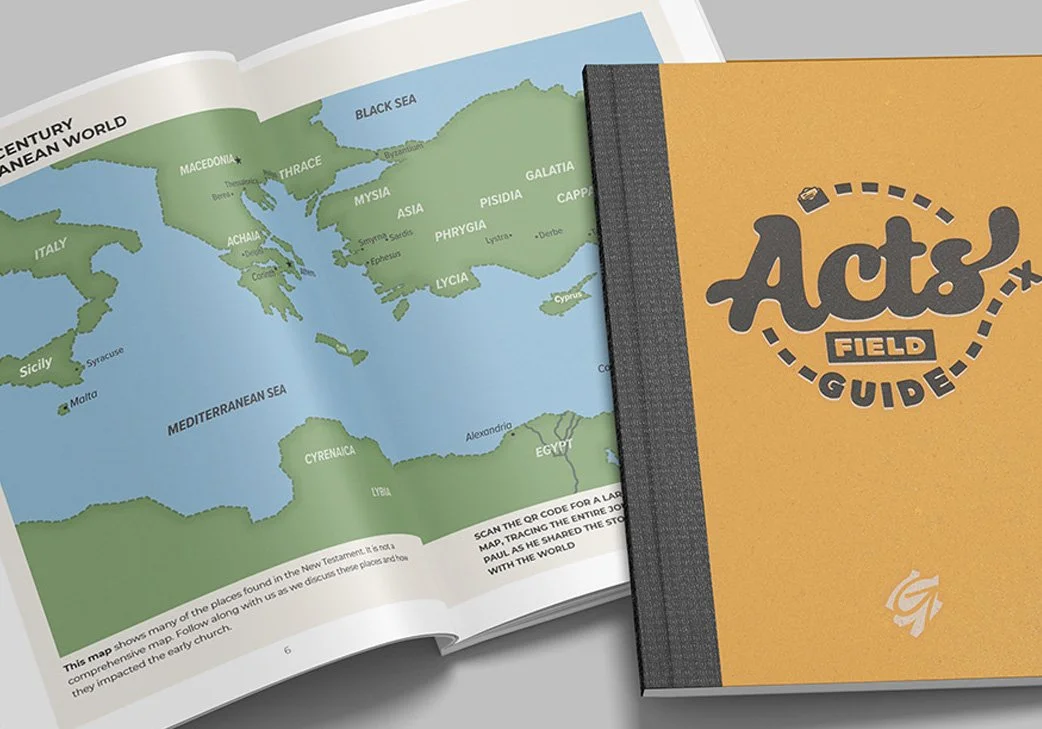
The Spirit is on the move. Download your Field Guide and bring it each week — there's space inside to write, reflect, and record what God is saying to you through Acts.
Digging Deeper
Digging Deeper: Step Out of the Margins
LEAN IN
- God is at work in all people, pursuing them so that they may come to know Him.
- Who was the “Phillip” in your life who helped lead you to know and follow Jesus?
LOOK UP
Main Passage: Acts 8:26-40
Make some observations (What does the text say?):
- Where was Phillip before this (vs 4-8)
- What does the angel tell Phillip?
- What do we learn about the Ethiopian official?
- What is Phillips’ starting point for sharing the gospel?
- What are you curious about in this passage?
- Anything that surprised you from this passage?
Make some interpretations (What does the passage mean?):
- Why do you think God directed Philip away from a successful ministry in Samaria to meet one individual on a desert road?
- What does this passage reveal about God’s heart for people from different nations and backgrounds?
- Why is it significant that the Ethiopian was reading Scripture but still needed someone to explain it?
- What does Philip’s response teach us about obedience and sensitivity to the Holy Spirit?
- Why do you think the Ethiopian responded so quickly to the message of Jesus?
- What role does Scripture play in leading the Ethiopian to faith?
- Why do you think Phillip disappears after the baptism?
- What do you learn about God?
- What do you learn about humanity (our expectations, limitations, or tendencies)?
Now make some applications (What’s my response?):
- Are there moments when God may be prompting you to slow down or notice one person in need of encouragement or truth?
- What keeps you from initiating spiritual conversations like Philip did?
- How comfortable are you explaining Scripture or sharing the gospel with others?
- Who in your life may be searching for the truth but needs someone to guide them?
- How can you become more attentive to the leading of the Holy Spirit in everyday life?
- What practical step can you take this week to engage someone spiritually?
Reflective Questions
Read Isaiah 53. This chapter is a prophetic passage about the coming Messiah- Jesus!
- What in this passage do you have questions about?
- What stands out to you?
- What inspires you?
- What do you learn about Jesus?
Scripture
- Acts 8:26-40
- Isaiah 53
Prayer Guide for Groups:
Gratitude and Thanksgiving:
- Thank God for who He is and how He is at work in your life.
Listening/ silence:
- Invite God to bring to mind anyone that He wants you to take a more active role with.
Intercession:
- Who is in your life who doesn’t know Jesus? Pray for them and for opportunities to share the good news of Jesus with them.
Practice (STEP OUT)
- Create your Oikos Map
Oikos is the Greek word for “household.” Many times in the New Testament when people come to faith, they immediately gather their “oikos” and tell them about the decision they made.
-
- Sometimes it was the community they lived around, like the Samaritan woman in John 4.
- Sometimes it was their family and close friends, like Lydia and the Philippian jailor in Acts 16.
- At other times, it was not just their friends and family but those they worked with, like Cornelius in Acts 12.
Who is in your oikos? It is likely God has put you in that place so that you can share the gospel with them and that they in turn could share the gospel as well.

Spiritually, where is each person that you’ve put on your Oikos map? Look at this chart and write the stage they are in beside their name on the map above.
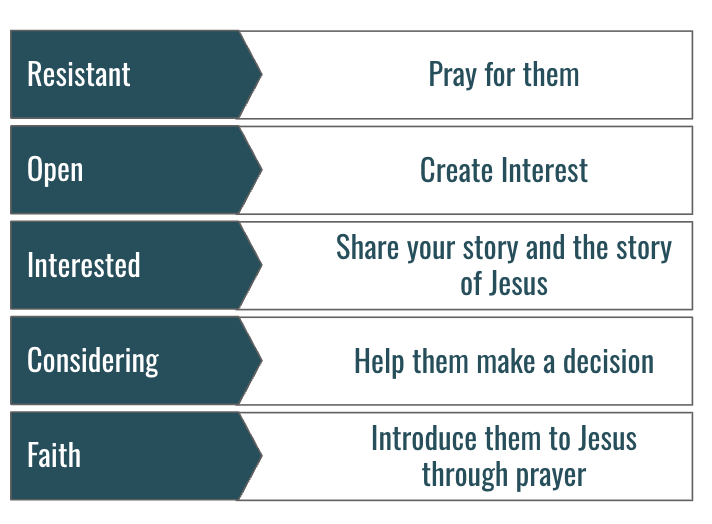
Take a step this week to begin praying for those on your Oikos Map and take one relational step.
Message Transcript
As you walked in, if it was your first time, hopefully, you grabbed one of these or you brought one back with you. Go and take it out. These are our field guides that over the next few weeks, we’re going to be following along in, and I’ve been doing mine throughout the week as I prepare for weekend messages and to kind of take notes every single week. This week we’re going to be on page 12 and 13 in week eight of this week’s message to go and take notes, and write some commentary down again. How amazing would it be that at the end of this series where we get to July, you look back on the last few weeks and you can kind of find your own roadmap of what God showed you or what stood out to you in some of these messages. So go ahead and do this, and we’re going to have them available every single week. So go ahead and bring them back with you. All right.
So let’s go back to the passage that Leanne already read for us this morning. Starting in verse 26, an angel of the Lord approached Philip. And by the way, Philip was like you and me before I became a pastor. Philip, if you remember, was a Grecian Jew. So he was a foreigner, even though he was in Jerusalem; he had a Greek background. He was considered an outsider. So he was an insider by religion, but an outsider as far as ethnicity. He, along with Stephen and five other men, were raised up within their community to do the important spiritual work of taking care of the widows and the poor. Those are in need, and if you ever wonder what really gets the heart of God, it is widows and especially poor children. As he was raised up in his community and they made a huge difference—that we studied a few weeks ago starting in Acts chapter six all the way through Acts chapter eight at the beginning of this chapter. Stephen, who was his cohort, was killed, and so they spread out. Philip is the first person we hear of doing great works to expand the kingdom of God. It’s not one of the apostles, not one of the disciples; we hear of Philip, a volunteer. He was part of the very first leadership team, the very first servant team. And Philip is being used in an amazing way.
So the angel of the Lord approached Philip, a volunteer, a man like you and I, and instructed him to go south to the desert road, the one that goes from Jerusalem to Gaza. So he started out, and on his way he met an Ethiopian eunuch, an important official in charge of all the treasury of Candace, queen of the Ethiopians. This man had gone to Jerusalem to worship. So a little context. The eunuch, the Ethiopian man, had already been to Jerusalem to worship. He’s on his road. You’re going to see what happens here, and Philip encounters him. It’s really important for us to understand that the angel had already spoken to Philip before. And now the spirit begins to whisper to him, go and do this thing, this weird thing. I mean, have you ever been driving down the road and you have this sense, gosh, I should take a right, and you have no business taking a right? Oh, I should do this. And that’s what Philip had. He had this inkling, this knowing that we call the Holy Spirit kind of guiding him, saying, go down to this road and just do what I ask you to do. So Philip is walking in obedience, even when things don’t make sense. He’s not like us in our nature, in our flesh, right? All of us revert back to that three-year-old in us. “Why?” You ever do that? “Why?” Or we say, “I need more clarity,” right? We say “What?” No, Philip just obeyed. He just does it. And here’s what’s interesting. The angel could have already gone down and spoken to the eunuch. But the call to the Great Commission from Matthew 28, the call to spread the good news of Jesus, was not given to the angels, was not given to spiritual beings. It was given to humans. It was given to us.
Matthew 28: Then Jesus came to them, humans, disciples, and said, “All authority in heaven and on earth has been given to me. Therefore go and make disciples of all nations, baptizing them in the name of the Father and of the Son and of the Holy Spirit, and teaching them to obey everything I’ve commanded you. And surely I’m with you always to the very end of the age.” This is Jesus, the one many of us believe in, the one many of us are exploring. He gave this good news, this call, this commission, not to the angels. He gave it to us. He’s entrusted us with this. And what do we find as Philip is obeying? As Philip is stepping in, he’s finding this man from Ethiopia. He’s a court official. Now Ethiopia, we know he’s from ancient Nubia, right, so it’s southern. It’s the southern part even beyond modern-day Egypt. When I went to Egypt a few years ago, we had some missions partners doing amazing work in that part of the world. It was interesting to see that when I was in Cairo, the northern part of the country, the people pretty much had the same skin color as I did. As far as tone, they spoke a different language, and many of them were a different religion. But as we went down further to the southern part of Egypt, the people got darker, like my grandma. In case you didn’t know, my grandma is Black, okay? The people got darker. There was a Nubian part of that ancient world called Nubia. So it’s in the southern part of Egypt and beyond. And here we find this man who’s in the court, an official from that part of the country, who traveled 200 miles to worship in Jerusalem.
You see, he wasn’t just doing it out of rote memory. He wasn’t doing it because it’s the checklist of the thing he’s supposed to do. He goes back to Jerusalem, even though, just so you know, according to the law, he could not fully be accepted into the community. In Deuteronomy chapter 23, one of the rules was that if you were a eunuch, you could be a God-fearer. You could be a proselyte, but you couldn’t be fully integrated into the community as a eunuch. So here he is, this man who’s not even fully accepted into this faith because, according to the law, as a eunuch, he could not be. And yet he takes it upon himself to travel 200 miles in search of something that is stirring in his soul, 200 miles in search for something that is just eating him alive. “I’ve got to know this thing.” He has this drive, this desire. And if we’re not careful, we complain about driving 20 miles here by car. And he went 200 miles by chariot. You see, there’s something about those who earnestly seek that gets God’s heart.
Now, because it’s mentioned, we want to make sure you understand some of the things we’re talking about. You might be saying, well, what is a eunuch? You might not want to know after I describe it. Here we go, a eunuch. It’s a castrated male. You guys got really quiet. I knew that was going to happen. As soon as I say castrated male. Yes. Sharp knife. Castrated. I’m going to say castrated about 20 times today. So you can get your fill of the word castrated. Why? Because we can get uncomfortable with the word like castrated. And this man had to live with the discomfort. Why was it not just uncomfortable? Because he had now been given to a life of service. So this is the rest of the description: a castrated male often accorded a high government position, such as the chamberlain of a sovereign or royal harem, particularly common in ancient Near Eastern and other Oriental courts. The employment of eunuchs in sensitive political roles was introduced through Mesopotamian influence into the Roman and Byzantine Empires. So even though these men lost their manhood physically, they were entrusted with power and authority because of their sacrifice. And yet, even though he had power and authority, this Ethiopian eunuch was still seeking and searching for more than power and authority. That’s why when Leanne mentioned, no matter how the bank account turns, no matter if you get the title you’re looking for, no matter when you finally graduate and you’re awarded the diploma, all the things that are mile markers in life we may want. This man had power and access to authority, access to money, access to leadership. He had access to everything in that time in that world people might want. He’s serving in the courts. He has the best foods. He has access to leadership. He is in leadership. And yet his soul thirsts.
He’s thirsty, and he represents for us many of us who are religious. Or maybe we read scriptures and we seek the truth, but maybe we haven’t quite yet either said we believe in Jesus or we believe in Jesus, but we haven’t grown to trust Him quite yet with our entire life. Because we can believe. But boy, we don’t fully believe until we can totally entrust our lives to Him. And here you have this Ethiopian eunuch saying, “I don’t even know what to do, but I’m doing something. I’m going to go on a road trip. I’m going to figure this out.” This happens all the time. Almost every weekend I’ll stand out in the lobby and somebody will come up and say, “Hey, I don’t even know why I’m here today.” Last weekend a woman came up. She was running to a different church with a different religion, and she was running late. She pulls up in the parking lot and she just comes into service. And after the service, she stops and she’s crying. She’s like, “I’m just searching it. I didn’t know this is what I was searching for.” See, when we search and we seek, God has a way of finding us and meeting us.
Look at verse 28: “And on his way home,” this eunuch, as he’s searching and he’s on his way home, “was sitting in his chariot reading the book of Isaiah the prophet.” So he’s heading home. He hasn’t really found what he’s looking for. He probably wrote the original U2 song, right? “I still haven’t found what I’m looking for.” He’s hungry. He just stops in the road and he starts reading. He has this insatiable desire to know something more. He is truly actively seeking. He’s putting himself in position to really know. Then in verse 29, the Spirit told Philip, “Go to that chariot and stay near it.” The chariot must have been within eye distance, right? “Go to that chariot and stay near it.” Philip ran up to the chariot and heard the man reading Isaiah the prophet. “Do you understand what you are reading?” Philip asked. “How can I,” he said, “unless someone explains it to me.” So he invited Philip to come up and sit with him. Again, you have an Ethiopian eunuch, more than likely dark-complected, ousted from the community, cannot fully engage with that religion because he’s a eunuch. A stranger comes up to him. Stranger danger! The stranger comes up and says, “Do you even know what you’re reading?” And he just opens up and he says, “I need somebody. Unless somebody helps me, I’m not going to know.” And then he invites Philip into the chariot. Remember, the chariot represents royal authority. The chariot represents his domain. So the eunuch invites Philip into his domain. But Philip had to put himself in position to even connect with him. So now they’re connected. Now they’re becoming friends. I imagine they’re like just two best friends already. This guy is hungry, but here’s what’s really interesting: both of them have God’s Spirit stirring in them in very different ways. God is stirring something. So Philip obeys. He runs down, and when he gets down there, the eunuch invites him into a relationship and says, “Yeah, I need somebody to teach me.”
You might be wondering, well, really, did Philip have this moment where the Holy Spirit told him these things? Yes. And here’s the thing we want you to understand. For many of you who’ve heard about this thing called the Holy Spirit, depending on your background, it might be like, well, the Holy Spirit is this really weird entity. And weird things happen when you have the Holy Spirit. Let me tell you what’s really weird. People are weird, and then they have the Holy Spirit. The Holy Spirit is not weird. It really isn’t weird. I know that his body is weird. As grown men wearing booty shorts and painting their faces to go cheer on their favorite college teams. But what is weird is somebody who is broke paying $100 for a round of golf. We’re weird. The Holy Spirit wants to whisper and to guide us in truth and righteousness. It’s a big difference. So Philip listens. Listen to this from Tyler Staton. He’s a pastor on the West Coast. He says, “The Holy Spirit is God’s personal, present and active presence with believers. The Spirit’s work is meant to be normal, ongoing, part of everyday Christian life, not some special feeling of the Holy Spirit. For a rare dramatic moment, we tend to look for God in the wind, in the earthquake and fire. When God’s native language is a whisper.” So God’s Spirit is going to work within those of us who are believers. But do we ever drown out the noise long enough for Him to guide us in truth and righteousness? So the Holy Spirit in this story is an active agent working within Philip, asking him to do things that maybe he doesn’t want to do. But here’s the truth: when the Holy Spirit invites us to reach others for Christ, He also empowers us to do the very thing.
You might be wondering why I’m trying to reach my friend for Christ, and I’m trying my best to teach or lead them, but man, we’re not really getting anywhere. Well, then just relax. We get all anxious and you know what we’re doing? We are projecting our anxiety on everybody around us. This thing called the gospel is supposed to be joy and peace in the Holy Spirit. And many of us project anxiety. I get it, I do understand. I remember when I came to Christ and my brother disappeared from our family for years and we didn’t know where he was. My mom and dad had so much fear and anxiety. He was far from God. He was doing his own thing and my parents were like, “What are we going to do?” Finally, I was probably 28 when this happened, I called my dad and I said, “Dad, chill out.” “But this is our son and what are we gonna do?” And I said, “Hey, I don’t even want to talk to you right now. Relax. Let the Holy Spirit do the work.” And when God’s Spirit does that work, it empowers us to then be able to have these conversations. How do we rest? The way Philip rested and just listened to what was happening. Because look what he encounters. He encounters a man who is sitting at his chariot reading out loud. How often do you go somewhere and see somebody reading a book out loud? Not very often, right? Unless you sit by somebody on an airplane who is really rude and doesn’t really care, and they’re reading out loud. But in this day and age, he had the posture of a student. And how often do you see students in elementary school reading out loud? All the time. He was reading out loud because he had postured himself as a student of the scriptures, and he was reading it out loud. And when he did that, it opened a door for Philip to sit with him and to be able to talk.
So what was he reading? Verse 32, the eunuch was reading this passage of Scripture: “He was led like a sheep to the slaughter, as a lamb before the shearer is silent. So he didn’t open his mouth. In his humiliation he was deprived of justice. Who could speak of his descendants, for his life was taken from the earth.” Then Philip began with that very passage of Scripture and told him the good news about Jesus. Get this: Philip is wanting to share Jesus with this random guy from another country sitting at a chariot, and when he goes to present Jesus to him and he’s reading scripture, what is he reading? He’s reading about Jesus. See, when the Holy Spirit is at work in our lives and the Holy Spirit begins to connect something, the Holy Spirit makes it a lot easier than we do in our complicated world. A few years ago, I was talking to a friend of mine on the phone, and I could tell that he was having a really hard time about something. I said, “Hey, just so you know, I was praying for you last week, and I just feel like, I don’t know what you’re going through, but I feel like God just wanted me to tell you it’s going to be kind of weird.” I made it awkward. He’s like, “Just spit it out, Carlos. You guys are going to have a baby.” He’s like, “What? That’s what I’m crying about. We haven’t told anybody. We can’t have kids.” I said, “Oh, guess I’m wrong. My bad.” Two weeks later, his wife calls me crying on the phone. “How did you know?” “What do you mean? What did I know?” “Because we’re pregnant.” I said, “I didn’t know, but I was praying for you guys and it’s what I sensed.” And so I just spoke what the Holy Spirit just told me to say. I didn’t have to go get anointing oil. I didn’t have to get weird. I don’t have to ask him to give $50 so I can pray a special prayer. When you’re in partnership with the Spirit of God, it is a free gift. It’s freely living. It’s not anxious, it’s joy-filled. And that eunuch is reading about Jesus, this suffering servant, this motif of Jesus who’s the servant of all, who suffers on our behalf, who doesn’t fight for His own life, but offers it up for you and I. This Jesus who faced the injustice of living a sinless life and yet was crucified for you and I.
What I’m sharing with you now is what he was reading. He just needed a little bit more explanation from Philip. So he’s getting explained to him what’s happening, and something begins to stir in him, because Philip’s explaining the verses, he’s walking with him and he’s not adding a bunch of stuff to it. He’s just showing him this is what it means to understand the gospel, and it begins to stir in him. He becomes a poster child for these two verses: Proverbs chapter eight, “Those who seek me, they find me,” and Jeremiah, “You will seek me and find me when you seek me with all your heart.” Do you think a man on a chariot for 200 miles on his own journey to seek was an example of seeking God with all of his heart? And yet God found a way through Philip and through the Holy Spirit at work in both of them at the same time for this moment. Philip explains that Jesus is the Messiah that he’s reading about in Isaiah and the prophecies of the Old Testament. And the eunuch believes. The eunuch says, “I believe in this Jesus.” “This is exactly what I’ve been looking for.” And now that the eunuch believes, it’s now on the eunuch to actually take some next steps. Philip could have said, “All right, you say yes to Jesus. Now I’m going to control your life. And here’s 50 things you’re going to do.” No. Once we say we believe, we have a responsibility to take some steps and some action to go along with our belief.
That leads us to this next passage in verse 36: As they traveled along the road, they came to some water, and the eunuch said, “Look, here is water. What can stand in the way of my being baptized?” Why do you think he asked that? If you remember, he’s a eunuch, and according to the law he can believe in God, but he’s not fully integrated into the family of God. So he’s wanting to know what other obstacles do we have? What are the obstacles do I need to know of? And Philip said, “If you believe with all your heart, you may.” And the eunuch answered, “I believe that Jesus Christ is the Son of God.” And he gave orders to stop the chariot. Then both Philip and the eunuch went down into the water, and Philip baptized him. All in these moments this man is seeking. He goes hundreds of miles. And yet, in the matter of moments with Philip, he understands the good news of Jesus. And he’s so excited about it that he sees a body of water. They didn’t go test it to see the balance. They just said, “Water. I want to be baptized.” And Philip says, “There’s nothing really stopping you unless you believe.” And the eunuch with his own words says, “I believe that Jesus Christ is the Son of God,” and he gets baptized. Here’s what you need to know about baptism. It’s a public act of faith. Imagine all the kids and all the students and all the adults who stand over here to my left when we celebrate a few hundred people the last year or two, coming to Christ, going public with their faith. What they’re saying is, “I am repenting of my sin. I believe that when I go down, I am dying with Christ. I’m coming back to life in Christ, the way Christ rose again from the dead. And I am now in a community of believers that I do this with. And they celebrate and they cheer me on, and I make them better, and they make me better, and they correct me and I might correct them. And we’re now in a community of people doing this together.”
It reminds me of Romans chapter six: “Or don’t you know that all of us who were baptized into Christ Jesus were baptized into his death?” Pause. Those of you who’ve been baptized, are you constantly reminded of your need to die? That’s what he’s saying. If you’ve been baptized and you said yes to Jesus and you’ve gone under, it’s not a one-time going under the water. It is a daily “What am I dying to myself over so that I can come back to life in Christ to be more like Christ?” “We were therefore buried with him through baptism into death, in order that just as Christ was raised from the dead through the glory of the Father, we too may live a new life.” We get baptized, the old is gone, and the new has come. One time my dad, who was a pastor, was baptizing this woman, and we had these concrete steps of the baptismal. They went too far, and she hit her head. She comes up cussing a storm because she was hurting. Somebody said, “I’m so sorry, put her back under just to make sure.” Because the old goes, but it’s a process. Everybody say, “I’m in process.” But some of us die in the process. Why? Because we don’t let the thing that needs to die, die. I promise you, you let it die, you come back to life in Christ. There’s going to be something else that needs to die. Verse eight: “For if we have been united with him in a death like his, we will certainly also be united with him in a resurrection like his. For we know that our old self was crucified with him so that the body ruled by sin might be done away with, that we should no longer be slaves to sin—because anyone who has died has been set free from sin.” When you say yes to Jesus and you have been baptized, you have the ability to be free from your sin and shame. So when we have sin and shame, it is by choice. When we have a Savior who wants to take that. “Now if we died with Christ, we believe that we will also live with him. For we know that since Christ was raised from the dead, he cannot die again; death no longer has mastery over him. The death he died, he died to sin once for all. But the life he lives, he lives to God.” And that’s our example. When we follow Christ in the way of Christ, that the death we die is to our sin, to our shame. And when we live, does our life look like something that we want to offer to God? And the eunuch is saying, “Yes, this is what I want.”
I wonder about you. Is this what you want? You might be a believer who has never been baptized. I don’t want to cast any shame on you. I want to give you an opportunity. Maybe you just accepted Christ recently, or maybe you’re in the process, saying “I want to say yes to Jesus.” In July we’re going to have baptisms again. There’ll be information on the screen. Go ahead and take a picture of it. Sign up for it. If you’ve never been baptized and you’re a believer in Jesus, sign up for it. All it is is somebody like Philip, a volunteer in our church, sitting with you, making sure you understand exactly what you believe. Right? Not about life in general, about who Christ is and your life in Him. And then we celebrate together life renewed in Christ. We do that together, not for us, for you. But then the body of believers gets the benefit. Look at verse 39: “When they came up out of the water, the Spirit of the Lord suddenly took Philip away. And the eunuch did not see him again, but went on his way rejoicing.” He went on his way, doing what he encountered. Philip came to know Jesus, got baptized, and he was filled with joy. Philip, however, appeared at Azotus and traveled about preaching the gospel in all the towns until he reached Caesarea. Joy. It’s one of the marks of the Holy Spirit. Not just a smile, not just good things happening, but a joy that is so profound because your soul has found life in Christ, even though your circumstances may not look well, even though your family might be all over the place, my soul is at rest in Him.
And here’s what’s really interesting about this: it is the Holy Spirit’s initiative. Especially for those of you who grew up in different kinds of churches, the Holy Spirit’s initiative is a relationship with Jesus. The goal of the Holy Spirit is for us to encounter Christ. The goal of the Holy Spirit is not for you to shout, not for you to yell, not for you to get emotional, not for you to get the goosebumps. The goal of the Holy Spirit is for you to know Christ more. And when you know Christ more, there might be all sorts of things that happen, but it’s about Christ, and it is the Holy Spirit who orchestrates these encounters. It’s God and God alone. Why is it important that we understand that? That we don’t go around to everybody pushing what we believe on everybody, because that means we are getting ahead of what God’s work is for that person. It doesn’t mean you can’t share the love of Jesus. It doesn’t mean you can’t be nice to people. But it means we are not the enforcers. We’re the enforcers of the Holy Spirit. We’re servants of God, used by God in the gentle whispers of God. Why? Because the gospel crosses cultural and social barriers, and if you do things on your own, many times you will break social norms for the very people you’re trying to reach. Because you and I are doing it in our own strength. But when we do it with the Holy Spirit, you have Philip, who’s Greek, and an Ethiopian, who have very little in common culturally. A Holy Spirit God encounter happens because Philip was just obedient. And why is it important that it crosses cultural and social barriers? Because this life in Christ is radically inclusive for everyone. It’s the most famous passage in Scripture: “For God so loved the world that he gave his only son, so that anyone who believes upon his name shall not perish but have everlasting life.” Sure, first to the Jew, but then to the Gentile. And now there is no Greek or Jew, there is no male or female. It is for all.
Quick encouragement and challenge before we end today’s message: for the believers who are here, those who said, “Yes, I believe in Jesus, I have surrendered my life to Christ.” Here’s a real challenge for you. Let’s be ready to follow specific, even inconvenient guidance from the Holy Spirit. When’s the last time you were just open, with open hands, to God doing something in your life with a gentle whisper? My wife the other day said, “Hey, I was getting coffee and somebody paid for my coffee because it just felt weird. What if they just felt led to?” “Yeah, but I felt bad they paid for my coffee.” Let them. One, it saved me five bucks. Two, and the most important thing, maybe they just felt led to share kindness. When’s the last time we just put ourselves in position for inconvenient guidance from the Holy Spirit? How do we do this as believers in Jesus? How do we cultivate an awareness of the Holy Spirit trying to whisper next steps in our ear? They’re going to be up on the screen.
First one is this: creating regular quiet space for prayer. You want to know what I do, because I have a crazy busy life and family? For years now, when I drive in to the church or I drive most places, I don’t turn on the radio. I just sit there. It’s not the best quiet place, but it helps me to quiet my mind. All of us are driving somewhere for five, ten, 15, sometimes 30, 45 minutes, or an hour. You’ll be amazed at what happens when you just turn off the noise and just sit there with your thoughts. Some of us won’t like it because we won’t like the thoughts, so we’ll turn up the noise. But if you do it long enough, you’re inviting the Holy Spirit into that place to maybe, just maybe, whisper some things in your ear. And then number two, we stay rooted in Scripture. Because here’s where it gets weird. “Well, Carlos, I heard this from God.” Okay. Where do you see that in Scripture? How do we stay rooted in Scripture? There are weird things that happen in religious circles. When I say weird, I mean weird. I met somebody a few years ago. She went to a church and her husband came to her one day and said, “Our pastor talked to me and he feels like you should be his second wife.” She said, “Excuse me?” Yeah. So they created a deal where he would share his wife with the pastor because the pastor said, “God told me.” And I would say, “Where do you find that in Scripture?” Okay, so we do listen for the voice of the Holy Spirit, but we also have to have a life rooted in Scripture. And then number three, we pay attention to recurring nudges and respond. Sometimes we don’t like the direction that we’re supposed to go, so we fight it. But what if you just gave in to it? What if you did the thing you don’t want to do, because God might be meeting you and someone else on the other side of that obedience? See, we stay active, attentive. Philip does this. He stays attentive to the Spirit. He started where the eunuch was. He explained Scripture with Jesus at the center, and he was willing to cross social and cultural lines so he could walk in obedience to the whisper of the Spirit. Just walk in obedience.
Now, for those of us who are not followers of Jesus, but we’re here, we’re exploring faith, and we haven’t quite made that decision to follow Jesus. Here’s a couple of things to keep in mind. Number one, we encourage you to continue to seek God with all of your heart, even when you don’t have all the answers. Ask anybody who’s been around for a while. Those of us who are a little bit older and have been following Jesus a long time, I have just as many questions today as I did back then. They’re not the same questions, but it takes a lifetime to know this God we proclaim. And number two, if you don’t know something, admit what you need help understanding. Lean into it. When we have Bible classes or Alpha available, lean into it, and then stay open to unexpected messengers. The eunuch had an unexpected messenger in Philip, and he stayed open to that relationship, and he came to a full understanding. And how about this: receive the good news of Jesus personally, not just intellectually. There’s an intellectual process called the study of the historical Jesus. You can get a master’s degree in this at a lot of universities where you can academically be in Scripture, academically understand the sociology, the maps, and what’s happening in Roman culture. Most people believe that Jesus existed, but you can have a master’s degree in historical Jesus and not have a personal encounter with the Christ. So yes, study and learn, but have a heart that’s open, and then don’t let past exclusion define your future inclusion. Don’t let your past exclusions define you, like the eunuch, who by the law was not allowed, but he pushed past that to encounter Christ fully.
So as we do this, I want you to see this on the screen. It’s called MAP. It’s an understanding of being intentional. I encourage you this week, sometime in your prayer time or just as a family, to map out intentionally who are the people that God has placed in your life: family, friends, your work, the gym you go to. You’re not mapping it out to say, “I’m going to win all these people to Jesus.” You’re mapping it out to have a humble heart that is open, saying, “Okay, God, these are the people you’ve put in my sphere of influence. What are their hurts? What are their hang-ups? What can I be praying about?” Maybe they need a meal. Maybe they just need a listening ear. It’s a posture of serving the people that God has put in your life, in my life. But sometimes we just need to sit down and map it out so that we can see with integrity and a genuine heart. “I’m praying for you. I’m considering you. I want to be your friend. I want to be a good uncle. I want to be a good sister. I want to be a good brother.” We do this with a genuine heart. Research shows that most people are open to you praying for them. Just don’t be weird about it. Be a normal person. If you don’t know how to be a normal person, we have a class for that. I’m kidding, we don’t have a class for that. We should have a class for that. Just interact genuinely with people.
We’re going to close our time together in prayer. I want you to posture your heart. We’re going to ask everybody to pray this, no matter where you are on the continuum of belief or unbelief, or if you’re fully devoted. I want you to go and stand as we read from this hymn that was written in the 1800s. We’re going to read it at the same time. Some of you need to stretch. I get it, and I’m going to read it with you. I’m going to pray for us, and we’re going to close out our service together.
“God be in my head and my understanding. God be in mine eyes and in my looking. God be in my mouth and in my speaking. God be in my heart and in my thinking. God be at mine end and at my departing.” Let’s pray. Lord, I thank you for friends or family that are in the room. Those of us who are on the continuum here exploring faith, or maybe we don’t even know why we came to church today, and those who’ve been following you, who are fully devoted followers and helping others to become that. Like this hymn said, at the end of our days, when all the breath has left our lungs, would we know that you are found there with us in our minds thinking, in our eyes seeing, in our mouth speaking. I pray for those who continue to explore faith that today they would have a new glimpse of who Jesus is, and that He is available and wooing and calling them to know you. And to my friends who have already said yes, that they would be reminded of this Jesus. This is the same Jesus who called them and lifted them out of miry clay, that gave them new life, and would we continually shed away the deathly parts of us so that we can live in your marvelous light. In Jesus’ name, Amen.