Good morning, everybody. It’s good to be with you. My name is Carlos, and I am your senior pastor. Will you help me welcome everybody who is watching online? You know, those people who are suffering on a beach somewhere or at a lake. Give it up for all of them. I know my own daughters took a quick little trip this weekend. They’re in Oklahoma. I wouldn’t vacation in Oklahoma, but whatever—we love you if you’re from there.
We have a few things going on today. One, it is Pentecost Sunday. If you don’t know what Pentecost Sunday is, it’s really important to the history of the church. Pentecost just means fifty. It celebrates fifty days from the resurrection of Jesus to the Upper Room. We’ve been covering this in our series on the Book of Acts, where the Holy Spirit descended on the people. Jesus told them to go and wait, promising to send another, and the Holy Spirit came. Church historians believe that was the beginning of the church. Here we are over 2,000 years later, celebrating together, exploring faith, and figuring out what this whole God thing and the local church thing is all about. It is Pentecost Sunday around the world, so you’re doing something that tens of millions of people are doing today by celebrating the Holy Spirit.
Because of that, we are called to make an impact. That is what the message is really going to be about today: Impact Sunday. Every year we do this to remind ourselves of what God is doing through our church around the world and in our own backyard. This year for Impact Sunday, we’re focusing on what God wants to do in the greater Austin area through our church and through people who are already doing amazing things.
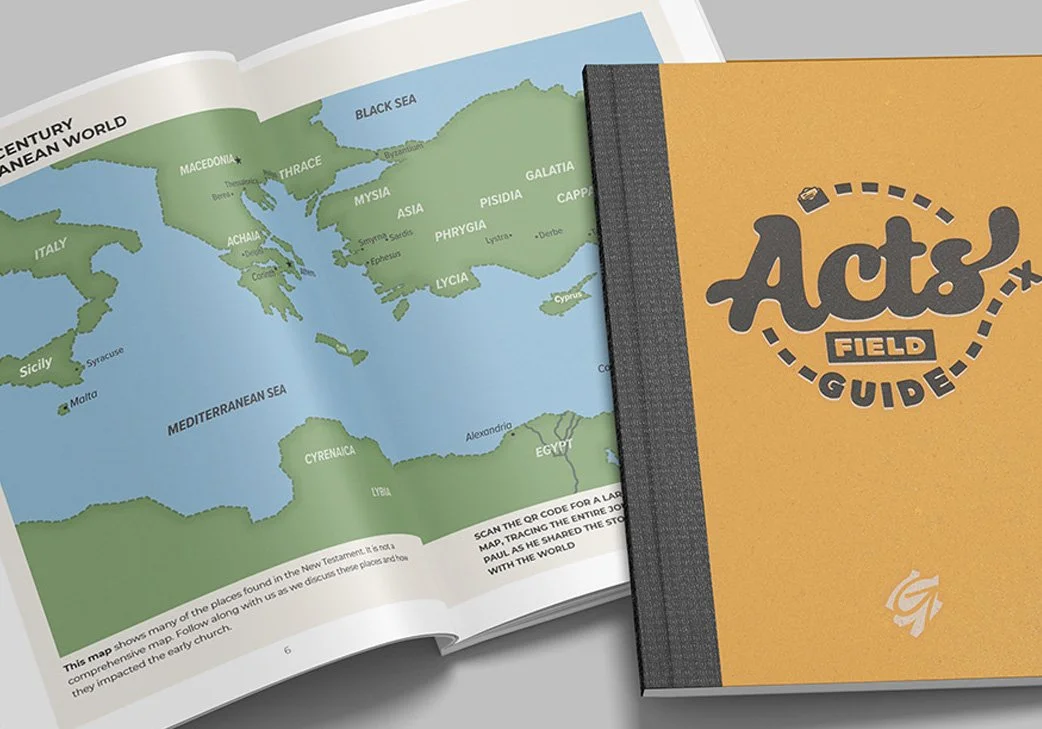
As you walked in, you received a booklet. Go ahead and take it out. In the seat back in front of you, there is an envelope. Take that out too. If you’re in the front row, it’s right behind you. Just ask the people behind you kindly if you can have an envelope, and they should say yes. If not, I’ll get down and get it for you myself. This book is inviting you into the journey of the next part of the Book of Acts. It maps out the different missionary journeys of the apostles. I want you to take this book and mark it up. Make notes in there, scribble, and bring it back with you every single week. As we follow the maps of the apostles traveling around the ancient world, ask yourself: what is God mapping out in your own life? At the end of the series in July, you’ll be able to look back on your notes and see what God showed you and what you learned.
Right in the middle of the booklet, on pages ten and eleven, is what we’re talking about for Impact Sunday. As your pastor, I felt we needed to invite everyone—every child, teenager, young adult, and adult—to participate in a $10 challenge called Bibles and Backpacks. We are partnering with local organizations connected to the life of our church to put God’s Word, the bread of life, into people’s hands and to help children with food. This initiative is fully focused on children. Their families and parents will also benefit, but the focus is the kids.
I am asking all of us to participate in this $10 challenge. I initially thought about asking our creative team to put $18 to $20 on the envelope—the average price of a lunch here in Austin, Texas. But I decided on $10 instead because it’s low-hanging fruit. Ten dollars buys a pretty bad lunch here—the kind of food that is not good for you, like McDonald’s or Wendy’s, but we eat it anyway. I am challenging my own kids to participate. One hundred percent of this money goes right toward Bibles and food. None of it is administrative or goes toward running our church; every dollar that comes in goes right back out to these ministries.
If you have your Bibles, please turn to Acts chapter eight. Today, we are exploring the idea of getting comfortable with being uncomfortable. You have probably had that moment where you get an unexpected phone call, a diagnosis, or a relationship breakup. Something blindsides you, and you suddenly go from being completely comfortable with your job, your money, or your relationships to feeling incredibly uncomfortable. We naturally dislike discomfort, and as humans, our immediate response is often to ask, “God, where are you ?” If you are exploring faith, you might ask, “If God is so good, why are these things happening ?” When things don’t go our way, we tend to assume that God is no longer with us.
My eleven-year-old son, Max, plays tackle football, and he is the smallest kid on the field. He is playing against twelve and thirteen-year-olds who have started puberty and are several inches taller than him. Yesterday, they played a team where three of the boys were my size. Max came home and said, “Dad, I don’t know if I want to go to practice. I’m getting my butt kicked.” As a good dad, I told him, “Son, this is good for your character. You’re going to thank me later.” I said all the right things until one practice where he came home and said, “You don’t love me. You made me go get my butt kicked .” His assumption was that he was in it entirely alone. When he is on the field, he might feel that way, but when he is preparing at home, I am right there with him. As a dad, I need to position my son to get comfortable with the uncomfortable.
If I feel that way as an earthly dad, imagine our Heavenly Father. Sometimes, the Spirit of God moves most powerfully through disruption—the very opposite of what we want. Think about the last time you watched a documentary or looked up to a hero, a business owner, or a doctor who cured a disease. Did any of them ever say that doing something amazing was easy and cost them nothing? My daughter wants to be an orthopedic surgeon. She has years of school ahead of her and will be studying until she is 32 because she wants to fix broken bones. I asked her why she wanted to stay in school for so long, but then I realized that at some point, I will need a new hip. Do I want a surgeon who watched YouTube videos to learn how to replace a hip? No, I want someone who spent thirteen years in school and residency perfecting their skill set by being comfortable with the uncomfortable.
That is what God does to us: He causes disruption in our lives so we can grow. This brings us to Acts chapter eight. The believers are highly uncomfortable because Stephen, one of the heroes of the early church, was just stoned to death.
We are going to cover three main ideas today. First, God uses disruption for direction. Second, growth happens outside of comfort zones. Third, obedience often requires movement. My prayer is that we would find peace in the disruptions happening in our lives right now so we can have the courage to move forward.
Let’s look at Acts 8:1: “And on that day a great persecution broke out against the church in Jerusalem, and all except the apostles were scattered throughout Judea and Samaria .” The apostles—those who had walked with Jesus for three years and saw Him after the resurrection—stayed behind, but everyone else was scattered. When we think of the word “scattered,” we often think of it negatively, like when a restaurant bill arrives and suddenly everyone runs to the bathroom, leaving you alone. But the Greek word used here is diaspora. Dia means to scatter or separate, and spora comes from the word meaning to scatter seed or to plant. The literal sense is that what looked like believers being driven away by fear was actually the gospel seed intentionally being planted everywhere.
Verse four says, “Those who had been scattered preached the word wherever they went .” Who was scattered? The everyday believers. The professionals and leaders stayed in Jerusalem, meaning ordinary men and women were the ones carrying the Word of Jesus and planting seeds. The church expanded because everyday followers carried the gospel into uncomfortable places.
When you experience a job change, a department shift, or an unexpected move to a new city like Austin, do you see yourself as a victim of change, or do you invite God into the discomfort? A friend of mine worked for a startup and was making great money in sales. The CEO recognized his leadership talent and moved him to a non-sales department with a flat salary because they didn’t want to keep paying his high commissions. Within two years, he excelled so much that his salary matched his original role. They moved him a third time, and he grew his salary yet again. His CEO eventually asked him, “No matter where we place you, you keep doing well. What’s going on with that ?” My friend replied, “You could put me over the janitorial department, and I will be the best leader in this organization.”
Do we have that kind of mindset? We are not victims of disruption. We have a God who goes before us, and we will be victorious because His Spirit is with us wherever we are planted. These early believers were fulfilling the prophecy Jesus gave in Acts 1:8, where He told them they would receive power from the Holy Spirit to be witnesses in Jerusalem, Judea, Samaria, and to the ends of the earth. They knew this was coming. God is not abandoning us just because our comfort isn’t being met; He is repositioning us.
Before coming to Gateway, my wife Libby and I were in Seattle, preparing to take over as senior pastors through a succession process. We loved Seattle, our kids loved it, and the church was growing, but the senior pastor and I were not seeing eye-to-eye on the actual transition. I told him I wouldn’t split a church, and the succession fell apart. We were humbled and embarrassed, and we moved back to Texas. While recovering in Dallas, I got the call to come to Gateway. Six weeks after arriving, COVID-19 hit, and it has been a beautiful but challenging journey repositioning our church.
For a long time, I wondered what God was doing in us during that painful season in Seattle. But recently, that same church in Seattle called to hire my son because they believed in him and wanted to pour into him under their new senior pastor. Libby and I went through a painful year and a half back then so that six years later, our son could step into a beautiful, thriving ministry where he is deeply loved. Your discomfort is often for a greater purpose than just you. God specializes in redemption. If we fully surrender, He can take an impossible situation and redeem it for His glory. Sometimes we are crying over dead things that need to stay dead, completely missing the new life God is setting right in front of us.
Our second point is that growth happens outside of our comfort zones. Look at verse five: “Philip went down to a city in Samaria and proclaimed the Messiah there .” Remember, Philip was an everyday volunteer raised up in chapter six, not one of the twelve apostles. He went to Samaria, a place of intense historical, religious, and ethnic tension between Jews and Samaritans. Jews traditionally avoided Samaria at all costs. Philip could have argued, “God, if you loved me, you wouldn’t send me to a place where I am hated .” But the Spirit said go, and Philip went.
The Holy Spirit consistently pushes the church beyond the arbitrary lines that human beings draw—beyond race, social class, and political tribes. The gospel will always confront our comfort zones.
Last year, our church gave my son and me tickets to the Texas versus Michigan football game. Texas won, but that’s not the point. We went to the game and sat right in the middle of the Texas alumni section wearing all of our Michigan gear. Talk about an uncomfortable zone! But my son made friends with everyone around us. Texas fans were telling us they liked Michigan too, and everyone was high-fiving. There was only one dad who was genuinely angry we were there. At one point, I turned around to high-five his three young kids, and he literally blocked my hand and said things I cannot repeat in church. His own kids looked at him like he was crazy.
We have to step into uncomfortable places because comfort zones preserve control, but mission requires surrender. When you see people raising their hands in church during worship, it might look weird to you. It is weird to a world that values self-sufficiency. Raising your hands is a physical sign saying, “God, it’s about you. I surrender control of my life, my kids, my money, and my health.”
When we step out in surrender, incredible things happen. Look at Trey Williams, a member of our church who launched Anyra Ministries. In Central Texas, 23% of kids face food insecurity. His program fills the weekend food gaps for children who get free meals at school during the week but go hungry on Saturdays and Sundays. They started in 2020 with 50 kids at one school, and this week they fed over 1,600 children across 52 schools. That is what happens when God’s people step out of their comfort zones.
We don’t do the $10 challenge as a gimmick; we do it to break up the soil of our hearts so that families get Bibles and children get fed. Look at what happened when Philip surrendered in verse six: “And when the crowds heard Philip and saw the signs he performed, they all paid close attention to what he said .” Verse eight concludes, “And there was great joy in the city .” An ethnic enemy came to town preaching the good news, and it brought profound joy to the margins. Some of the greatest breakthroughs in our lives exist right on the other side of discomfort. We often try to place strict parameters on God, telling Him how much we will give or how often we will attend church, and then we expect Him to perform a miracle within those boundaries to save our marriage or our kids.
The early church lived with a radically different mindset than we do today. Modern culture asks, “What makes me comfortable ?” The early church asked, “Where is the Spirit moving ?” We ask, “What meets my preferences ?” They asked, “Who needs the gospel ?” We ask, “What fits my lifestyle ?” They asked, “How can we serve ?” Have we confused spiritual maturity with spiritual comfort? Following Jesus does not get easier as you get older; it demands more of your surrender. Your soul does not have a retirement plan.
Our final point is that obedience requires movement. Philip moved to Samaria and encountered Simon the Magician, who performed tricks and sorcery. Simon saw that the power of the Holy Spirit in Philip was real and authentic, so he believed. But then Simon offered them money and said, “Give me also this ability so that everyone on whom I lay my hands may receive the Holy Spirit .” Simon wanted the gifts and the spiritual influence without repentance, transformation, or surrender.
Young couples often come to Libby and me and say, “We want a marriage just like yours .” I tell them, “No, you don’t .” They get confused, but I explain that a deep marriage requires a lot of hard work, talking, crying, and walking through sorrow and discomfort together. This week was incredibly heavy for us; all five of our kids needed our intense emotional attention at the exact same time. We were exhausted. But because we have spent 26 years fighting through the uncomfortable, moving a dozen times, and surrendering to God together, our relationship is better now than when we first started.
God sees you in your darkest places, your addictions, and your history, and He asks if you will keep moving toward surrender rather than self-sufficiency. In the Christian life, those are the only two directions available. Jesus modeled ultimate movement for us by making Himself nothing and crossing the ultimate divide to reach us.
Where is God asking you to move today? Take that envelope in your hand. For some, ten dollars is a massive sacrifice; for others, it’s pocket change. Hold it up as a physical sign of your first step of surrender. Let’s ask God to use this challenge to prick our hearts, break up our self-sufficiency, and bring great joy to the city of Austin.